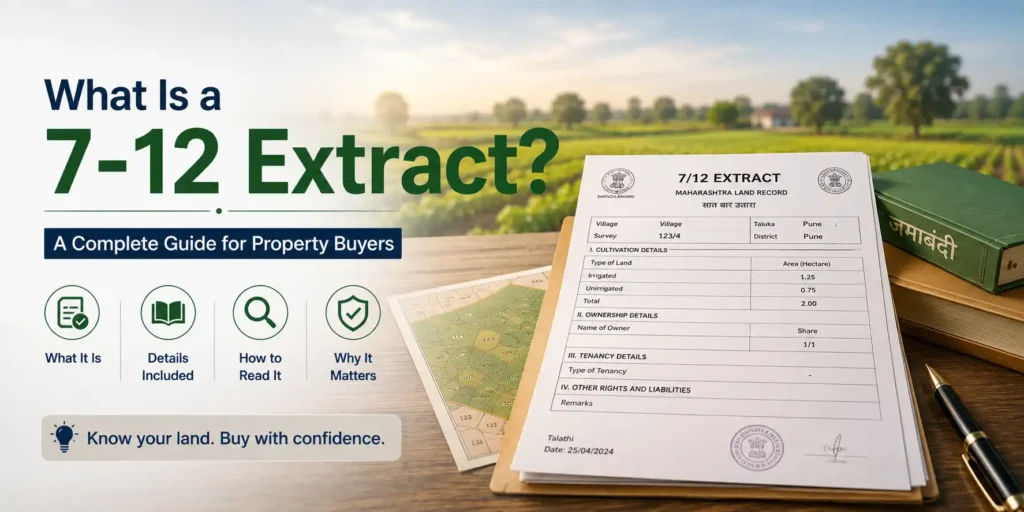
Purchasing land is a large investment; therefore, verifying its legal status is essential. In Maharashtra, one of the first documents a buyer must check is the 7/12 extract, commonly known as the Satbara Utara. This revenue record provides information about cultivation history, land ownership, and other important details that can help buyers identify potential legal or financial issues before completing a purchase.
For those wondering what is 7/12 extract, how it is interpreted, and why it matters, this guide can prove to be beneficial.
What Is a 7/12 Extract?
The 7/12 extract of Maharashtra is an official land record that the Maharashtra Revenue Department maintains. It is a combination of forms 7 and 12, where the former records ownership and legal rights over the land and the latter contains information about cultivation and agricultural usage. Combined, they offer an overview of a particular parcel of land.
This is an important document for property transactions, updating revenue records, and agricultural loans. It must, however, be noted that buyers must verify it along with registered title documents and other legal records.
Why Is a 7/12 Extract Important Before Buying Land?
Assessing the 7/12 extract of Maharashtra can help buyers check important aspects of the property before they make a financial commitment. Key reasons a check is important include:
- It helps confirm the name of the recorded owner for preliminary land ownership verification in Maharashtra.
- It offers the correct survey number and total land area.
- It reveals current mutation entries, indicating if ownership changes have been correctly recorded.
- It helps access cultivation details, helping buyers understand how the land has been used.
- It may offer information about loans, mortgages, or certain encumbrances recorded against the property.
- It can support land title verification when it is viewed with registered deeds and other legal documents.
What Information Is Included in a 7/12 Extract?
Knowledge of the contents of the satbara utara can simplify the identification of discrepancies before purchasing land. Generally, it contains the following information:
- Owner Details
The document has the names of the co-owners and the current landlord. Buyers must verify if the name matches the seller’s identity and the registered sale documents.
- Survey Number and Land Description
Each land parcel has a survey number that is unique, which is mentioned in the extract along with the specification of the taluka, village, district, and total land area.
- Land Classification
The record confirms whether the land is agricultural or falls under some other category. This information is important for planning future development or land conversion.
- Cultivation Details
The cultivation details are included in the Form 12 section, which includes seasonal agricultural information and crops grown. This helps access the agricultural usage history.
- Mutation Entries
Mutation entry records changes can arise from sale, partition, inheritance, or other transfers. Buyers must check if all ownership transfers have been updated officially in the revenue records.
- Encumbrances or Liabilities
Some extracts may reflect charges against the land or loans. If any liabilities appear, buyers must get clarification before beginning the transaction.
How to Read 7/12 Extract Step by Step
- Step 1: Verify Basic Property Details
When you begin checking the taluka, district, village name, and survey number. Confirm that these details match the land that is offered for sale.
- Step 2: Check the Owner’s Name
Compare the name of the owner in the extract with the seller’s identity documents and registered title deed. You can investigate mismatches before you proceed.
- Step 3: Review the Mutation History
Examine each mutation entry to check ownership changes over time. Make sure that recent transfers have been recorded by the Revenue Department.
- Step 4: Examine Cultivation Information
Check the cultivation details and verify how the land has been used, that is, if the land has been actively used for cultivation.
- Step 5: Look for Loans or Encumbrances
Verify if there are any government charges, mortgages, or recorded financial liabilities. When encumbrances are unresolved, further legal verification may be required.
- Step 6: Cross-Verify with Other Documents
Though the 7/12 extract Maharashtra offers important information, it must be verified along with the registered sale deed, property title documents, encumbrance certificate and identity documents of the seller.
How to Check 7/12 Online Maharashtra?
The land records of Maharashtra are available online through the Mahabhulekh portal. Understanding how to check the 7/12 land record can help perform due diligence before purchasing land:
- Visit the official Mahabhulekh website.
- Choose the appropriate region
- Choose the district, taluka, and village where the land is located.
- Search using the survey number, Gat number, owner’s name, or other available identifiers.
- View and download the 7/12 extract for reference.
Although the online record offers the latest information, before finalising a transaction, it can be best to obtain the latest certified copy from the local Revenue Department and have all records assessed by a legal professional.
What Red Flags Should Buyers Look for in a 7/12 Extract?
A satbara utara helps identify the recorded owners but also the warning signs for further investigation:
- Multiple or Conflicting Ownership Claims
If multiple individuals have been recorded as landholders, make sure that all co-owners have agreed to the sale to avoid disputes.
- Pending Mutation Entries
A mutation entry that has not been finalised may indicate that changes in ownership are still being processed. Buyers must then wait for the updates to be completed.
- Existing Loans or Encumbrances
It may indicate charges or loans against the property. If the land has been mortgaged, make sure that the liability has been cleared.
- Mismatch in Property Details
Details such as the survey number, land area, and the owner’s name must match the registered sale deed and other documents.
- Restrictions on Land Use
The extract may indicate tenancy, government acquisition, or restrictions related to other legal matters, which must be verified before purchase.
How Does a 7/12 Extract Help Verify Land Ownership?
One of the main reasons buyers request a 7/12 extract in Maharashtra is to start the process of verifying land ownership in Maharashtra. The document identifies the recorded holder of the land, traces ownership changes through mutation entries, and confirms the property’s location and survey number.
However, it is essential to understand that a 7/12 extract is a revenue record and not a title document. Though it provides details about revenue records and possession, it does not establish legal ownership.
What Is the Difference Between 7/12 and Property Title Documents?
The difference between the 7/12 extract and property title documents is as follows:
| 7/12 Extract | Property Title Documents |
| Maintained by the Revenue Department | Registered under property registration laws |
| Majorly a revenue record | Legal proof of ownership |
| Contains cultivation details, survey number and revenue information | Records the legal transfer of ownership |
| Shows mutation entries and land usage | Establishes ownership rights |
| Used for revenue administration, loans and agricultural purposes | Used during sale, transfer and legal verification |
As the two complement each other, buyers must verify them both before purchasing land.
How Can Buyers Verify Agricultural Land Using a 7/12 Extract?
If you are purchasing agricultural land, the 7/12 extract becomes an important part of the verification process. However, it should be verified alongside these documents for better evaluation:
- Registered sale deed
- Previous chain of title documents
- Mutation records
- Encumbrance Certificate
- Property map or village map
- Identity documents of the seller
- Any required permissions for transfer, where applicable
Buyers must also physically inspect the property to confirm that the land boundaries correspond with the official records.
Conclusion
Knowing what a 7/12 extract is can help individuals purchase agricultural land in Maharashtra. The document offers valuable insights about survey number, cultivation details, mutation entries, and more, helping buyers identify various issues beforehand. The 7/12 extractis important; it must not be considered along with other documents. This provides a more reliable basis for making an informed investment decision.
FAQs About 7/12 Extracts and Land Verification
1. What is a 7/12 extract used for?
It is used for recording revenue information associated with agricultural land, including land ownership, cultivation details, survey number, and mutation entries.
2. Is a 7/12 extract proof of ownership?
No. Though it is an official revenue record, it is not proof of legal ownership. The title documents and other legal records must also be checked.
3. How can I download a 7/12 extract online?
You can download the 7/12 extract by visiting the Mahabhulekh portal, selecting the relevant district, taluka and village, and searching using the survey number, Gat number or owner’s name.
4. What information is available in a Satbara Utara?
A satbara utara can include details of the recorded owner, survey number, land area, cultivation details, crop information, mutation entries, and certain revenue-related remarks.
5. How often is a 7/12 extract updated?
The Revenue Department updates the extract whenever approved changes such as inheritance, sale, partition, or other ownership-related transactions are recorded through mutation.