Can You Buy Agricultural Land in Maharashtra? Rules & Eligibility (2026)

Purchasing agricultural land is often a valuable long-term investment. However, it is governed by strict legal provisions in Maharashtra. It is therefore important to check and understand the agricultural land rules Maharashtra before initiating a purchase. These rules include eligibility, ownership limits, usage, and compliance under broader land-related laws in Maharashtra.

Who Can Buy Agricultural Land in Maharashtra?

Under the current land laws Maharashtra, only farmers are allowed to purchase agricultural land. A farmer is any individual who already owns agricultural land or whose primary income is derived from farming.

This rule protects farmers, helping prevent the misuse of farmland for non-agricultural purposes. It also helps protect rural livelihoods. For the assessment of eligibility, land ownership records, proof of income, and proof of identity, among other documents, may be evaluated.

Can a Non-Farmer Buy Agricultural Land in Maharashtra?

In most cases, no, a non-farmer cannot directly purchase agricultural land in Maharashtra. As per the farmland purchase rules, you must be an adult Indian farmer to purchase such land. However, there are some exceptions:

  • Conversion of land to non-agricultural use (NA land) before purchase
  • Inheritance of agricultural land

What Are the Rules for Buying Agricultural Land in Maharashtra?

The agricultural land rules Maharashtra that determine farmland transactions include various important checks:

  • Farmer Eligibility: The buyer must be an agriculturist. They must also hold documents that prove their eligibility.
  • Land Ceiling Limits: Under the Land Ceiling Act of 1961, there is a limit on how much agricultural land an individual can hold.
  • Zoning Compliance: The land must adhere to local zoning laws and must be zoned for agricultural use.
  • Clear Title: The title of the land must be verified, and the farmer status of the seller must be confirmed. The verification of ownership is possible through the land ownership records.
  • Encumbrance Check: A buyer must ensure that they avoid a disputed land or one that is  bound by loans.
  • Stamp Duty and Registration: During the purchase process, it is mandatory to pay the required stamp duty and register the land at the Sub-Registrar’s Office (SRO).

How to Convert Agricultural Land to NA Land in Maharashtra?

The process of agricultural land conversion to NA Maharashtra is essential if the land is intended for residential or commercial use.

Step-by-step process:

  1. Application Submission

The land owner or applicant must apply to the local revenue authority (Tehsildar or Collector) along with a non-judicial stamp.

  • Document Verification

Multiple documents must be submitted. It may include ownership proof, land records, layout plans, and NOCs from authorities.

  • Premium Payment

After official assessments in the collector’s office, premium rates are determined based on land use. Once the payment is completed, an order of land conversion is initiated.

  • Issuance Of the NA Order

After payment, the collector issues an NA order, permitting the non-agricultural use. The land is then officially classified as NA land.

Without this conversion, agricultural land cannot legally be used for non-agricultural purposes.

What Documents Are Required to Buy Agricultural Land?

The documents required for buying agricultural land include:

  • Identity proof (Aadhaar card, PAN Card, Voter’s ID)
  • 7/12 extract (Satbara Utara)
  • Land area certificate
  • Soil testing report
  • Title deed and past ownership records
  • Encumbrance certificate
  • Aadhaar and PAN of the buyer and seller
  • Sale agreement
  • Land tax receipts
  • Mutation records

These documents help verify ownership, usage history, and legal status.

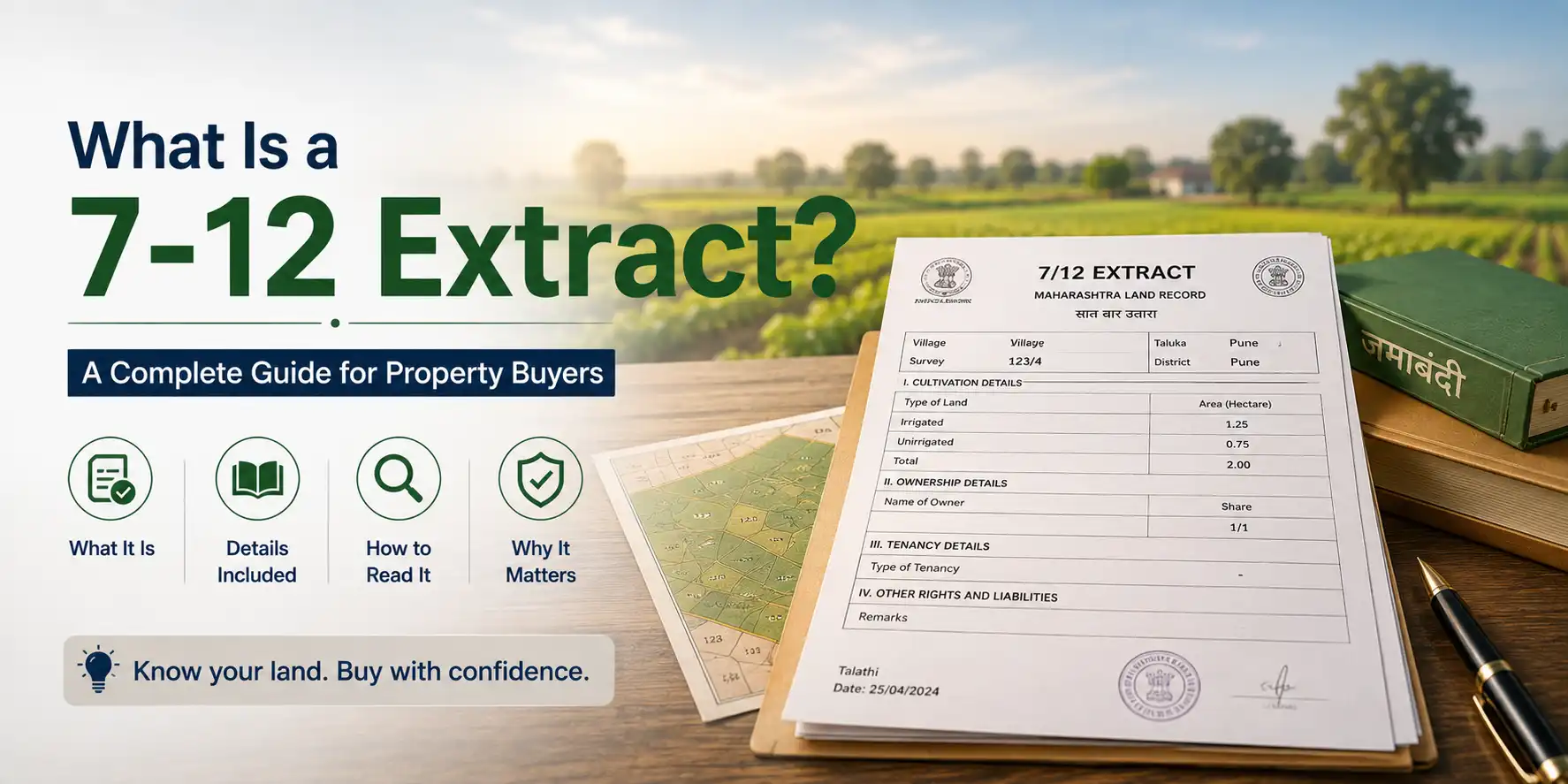
What Is a 7/12 Extract and Why Is It Important?

The 7/12 extract is an official land record maintained by the Maharashtra revenue department. It comprises a summary of an agricultural plot, showcasing information about who owns it, its usage, and other financial and legal information. The term ‘7/12’ comes from two forms, VII and XII. These record ownership and cultivation details. The critical information presented on the 7/12 extract includes:

  • Ownership details  
  • Land area and boundaries
  • Type of cultivation on the agricultural land
  • Rights and encumbrances

This document is crucial for verifying land ownership records and ensuring the land has a clear legal status before purchase.

What Are the Risks of Buying Agricultural Land in India?

While an agricultural land can be a good investment, there are risks associated with farmland rules India:

  • Legal Disputes: Inherited land may often have multiple legal heirs, which may lead to long-term litigation.
  • Fraudulent Transactions: Individuals must understand document requirements in Maharashtra. A lack of information about the purchase process and formalities can make them vulnerable to fraud.
  • Conversion Challenges: Conversion of a fertile agricultural land into a residential property is difficult. Therefore, if such land has been chosen, the buyer can face many difficulties.
  • Land Ceiling Violations: The Land Ceiling Act imposes restrictions on land ownership. Breaching these limits can lead to legal trouble.

How to Verify Agricultural Land Before Buying?

To minimise risks, follow this practical checklist:

  • Verify ownership through official land ownership records
  • Check the 7/12 extract for authenticity and updates
  • Obtain an encumbrance certificate to confirm no liabilities
  • Ensure compliance with local zoning laws
  • Confirm seller identity and authority to sell
  • Conduct a physical site inspection
  • Consult a legal expert for due diligence

These steps help ensure a secure and legally compliant transaction.

Conclusion

Understanding the agricultural land rules Maharashtra is important before investing in farmland. From eligibility restrictions to documentation and conversion processes, each step must be carefully followed. By staying informed about who can buy agricultural land in Maharashtra, legal requirements, and verification methods, buyers can make accurate legal decisions in 2026.

FAQs About Agricultural Land Rules in Maharashtra

1. Can a non-farmer buy agricultural land in Maharashtra?

Typically, non-farmers are not allowed to buy agricultural land in Maharashtra. Only agriculturists have this right. A non-farmer may become eligible by getting special permission from the district collector or through inheritance or other legal routes.

2. What is a 7/12 extract in Maharashtra?

The 7/12 extract (Satbara Utara) is an official land record issued by the Maharashtra government. It contains details such as ownership details, land area and boundaries, type of cultivation on the agricultural land, and rights and encumbrances.

3. How to convert agricultural land to NA land?

To convert agricultural land into NA land in Maharashtra, you must apply to the local collector, submit essential documents, gain approvals from various authorities, and pay the NA conversion charges.

4. Can NRIs buy agricultural land in India?

No, Non-Resident Indians (NRIs) are not allowed to purchase agricultural land in India. They can only inherit such properties or receive them as a gift from an Indian resident.

5. What is the maximum land holding limit in Maharashtra?

Under the Maharashtra Agricultural Lands (Ceiling on Holdings) Act, the maximum landholding limit varies based on land type and irrigation. While irrigated land may have a lower limit, dry land typically has a higher limit.

6. What are the risks of buying farmland in India?

Buying farmland in India carries risks such as legal disputes from multiple heirs, fraudulent transactions due to poor documentation awareness, conversion challenges, and violations of the Land Ceiling Act.

How Home Loan Process Works in India in 2026

Purchasing a home is a major financial milestone, and home loans have simplified the journey toward it. Understanding the home loan process in India can ease the process further. Whether you are a first-time buyer or are purchasing a new property, an understanding of the home loan system can enhance your chances of loan approval.
This step-by-step guide will help gain holistic insights into the home loan process in India.

What Is a Home Loan and How Does It Work?

A home loan is an aid offered by financial institutions that enables the purchase, construction, or renovation of a property. The bank offering the loan covers a large amount of the property costs upfront. The borrower repays this amount over time through monthly instalments (EMIs). This includes the principal amount and the interest.
A loan is typically repaid over a fixed tenure, and the property acts as collateral until complete repayment.

Who Is Eligible for a Home Loan in India?

Home loan eligibility India depends on several factors. These are assessed by the bank and determine approval. The applicant must be an Indian resident or an NRI and must fulfil other criteria:

  • Income level: An individual must have a minimum salary of ₹10,000 or ₹20,000 per month. The higher the income, the higher the eligibility may be.
  • Age: For self-employed and salaried individuals, the age limit for a home loan is between 21 and 65 years.
  • Credit score: Often, a 700+ CIBIL score increases approval chances. A high score can also make you eligible for a better interest rate.
  • Employment type: Home loans can be approved for both salaried and self-employed individuals with consistent income.
  • Existing liabilities: If you are paying for an existing loan or are in debt, the chances of loan approval may be low.
  • Repayment capacity: Banks usually prefer that the borrower’s EMI payments do not exceed 40–50% of their monthly income.

How to Apply for a Home Loan in India Step by Step?

If you’re wondering how to apply for home loan in India, here is a clear, step-by-step process:

  1. Assess Budget and Check Eligibility
    Before applying for a home loan, it is important to evaluate your financial position. Consider your monthly income and expenditure. Check if an EMI will be manageable. To simplify the process, you can use online tools for EMI calculation.
  2. Check and Improve Your Credit Score
    Your CIBIL score directly affects loan approval. You must therefore clear any outstanding dues before applying. Ideally, keep your CIBIL score above 700.
  3. Compare and Choose the Right Bank
    Before you settle for a loan, you must do your research. Go through various banks’ loan terms. Evaluate important aspects such as interest rates, processing fees, loan tenure options, and customer service.
  4. Submit Loan Application
    Once you have finalised which loan you want to apply for, start with the process. Go to the bank’s website or visit the bank branch and fill out the application for the desired loan. Ensure that the personal, financial, and property details are accurate.
  5. Submit Documents
    Post application, you will be required to submit essential documents. These typically include income, identity, and property proofs.
  6. Pay the Application Processing Fee
    Before submitting the application, you may have to pay a processing fee. This may be charged by the bank to initiate evaluation.
  7. Wait for Verification and Checks
    The bank or lender will typically verify your profile and financial standing. This can include employment and income details, repayment capacity, and credit history. The bank conducts a technical inspection of the property along with a legal verification of ownership and approvals.
  8. Sign the Sanction Letter
    If, after evaluations, the bank views you as eligible for the loan, they will sanction a letter. This may include the approved loan amount, interest rate, tenure, and EMI details. You must review this letter and sign it.
  9. Sign the Agreement and Wait for Disbursal
    A formal agreement is executed between you and the bank. This agreement comprises all terms and conditions. The loan may then be disbursed, fully or in stages, depending on the property status.
  10. Begin EMI Repayment
    As per your agreement, you can start repaying the EMIs. This will continue until the loan is closed.
    An understanding of this step-by-step home loan process in India can help simplify the application and approval process.

What Documents Are Required for a Home Loan

Here is a structured list of documents required for home loan :

Identity and Address Proof

  • PAN card
  • Aadhaar card / Passport / Driving licence

Income Proof

  • Salary slips (last 3–6 months)
  • Bank statements
  • Income Tax Returns (for self-employed applicants)

Employment Details

  • Employment certificate or business proof

Property Documents

  • Sale agreement
  • Property title documents
  • Approved building plan

How Much Home Loan Can You Get Based on Salary?

The loan amount that you are eligible for depends on your creditworthiness. Your net in-hand salary is also a determinant. If you have a good credit score and no existing debt, you can get a high loan amount. An example of a home loan based on salary is as follows:

  • Monthly salary: ₹50,000
  • Maximum EMI: ₹15,000–₹20,000
  • Approximate loan eligibility: ₹20–30 lakh (depending on tenure and interest rate)

Using an EMI calculator, you can estimate affordability before applying.

What Is the Interest Rate on Home Loans in India?

The Home loan interest rates in India usually vary based on market conditions and borrower profile. They can start around 7% per annum for leading banks. Most banks offer floating interest rates, which change with market conditions. Choosing between fixed vs floating rate depends on your risk tolerance and financial planning.

How Long Does Home Loan Approval Take?

Home loan processing time typically depends on factors such as verification requirements, documentation completeness, and internal assessment procedures. For salaried individuals, the process can take about 4-5 business days. For self-employed individuals, the process can take around 7-10 business days. For banks, completing due diligence may take time, which can result in approval delays.

What Are the Common Reasons for Home Loan Rejection?

Understanding the reasons for loan rejection can help you avoid mistakes:

  • Low Credit Score: Quite often, this is a prominent reason for loan rejection. While determining creditworthiness, CIBIL does not take income into consideration.
  • High Existing Loans Or Liabilities: If you are in debt owing to previous loans, the bank can reject your loan. This is usually because liability is higher than your income.
  • Insufficient Income: If you lose your job or quit during the loan application, your bank may discover this information during a background check. Due to a loss of repayment capacity, the loan may then be rejected.
  • Errors In Documentation: If you have submitted false information or provided incomplete documentation, your loan can get rejected.

It is important to ensure financial stability and application accuracy. This can help avoid rejections.

How to Increase Your Chances of Home Loan Approval?

If you want to know how to get home loan easily, follow these practical tips:

  • Maintain a CIBIL score above 700
  • Reduce existing debts before applying
  • Choose a longer loan tenure to lower the EMI burden
  • Ensure all documents are accurate and complete
  • Apply with a co-applicant to increase eligibility
  • Choose a loan amount within your repayment capacity

These steps can significantly improve approval chances and help you secure better terms.

Conclusion

Understanding the home loan process in India is essential for making informed financial decisions. From checking eligibility to final approval, each step plays a crucial role in determining your loan success. By maintaining a good credit profile, preparing the right documents, and choosing suitable loan terms, you can navigate the process efficiently and move closer to owning your dream home.

FAQs About Home Loan Process in India

What is the minimum salary required for a home loan in India?

The minimum salary required for a home loan in India can range between ₹10,000 and ₹20,000 per month.

How much home loan can I get on my salary?

How much home loan you can get depends on various factors, along with your net monthly salary. Usually, individuals can get a home loan of up to 60 times their salary.

How long does home loan approval take

For salaried individuals, home loan approval can take around 4-5 business days, whereas for self-employed individuals, approval may take 7-10 business days.

Can I get a home loan with a low CIBIL score

You can get a home loan with a low CIBIL score. However, you must provide specific documents and make a higher down payment

Can self-employed people get home loans?

Yes. Self-employed people can get home loans. To approve loans, banks check business stability, profitability, and income consistency.

Documents Required for Buying Property in India in 2026

Home ownership can be a lifelong dream for many. Although it is often an exciting period, entering the realm of property purchasing can be overwhelming. Legal jargon can be confusing, and when unguided, paperwork can seem endless. Acquiring information about the documents required for buying property in India can make the home-buying process slightly less complicated. Understanding document requirements can also help dodge the risk of fraud, legal disputes, or delays in ownership transfer.

This guide covers document requirements, helping you understand what to check, why it matters, and how to protect your investment with accurate due diligence.

What Are the Basic Documents Required for Buying Property in India?

The required property legal documents India is as follows:

  • Sale Deed
  • Title Deed
  • Encumbrance Certificate
  • Occupancy Certificate (OC)
  • Completion Certificate (CC)
  • Approved Building Plan
  • Property Tax Receipts
  • No Objection Certificates (NOCs)
  • RERA Registration Details

This is a simple checklist before buying property in India which helps form the foundation of legal ownership and compliance.

Why Are Property Documents Important Before Buying?

Property verification documents are crucial for these reasons:

  • Legal Ownership: When you possess documents like the title deed, it helps confirm that you are the property’s legal owner and have the right to transfer ownership.
  • Avoidance of Fraud: If documents are verified accurately, you can ensure that important paperwork is not missing or incorrect. This safeguards you against ownership disputes, land use issues, or stay orders.
  • Loan Approvals: The documents required for buying property in India must be verified, as banks may require them before approving a home loan. Incomplete or unverified documentation can lead to approval delays or rejections.
  • Verification of Tax and Dues: When you check tax receipts, you ensure that there are no outstanding property taxes or dues to local authorities.

What Documents Should You Check Before Buying Property?

The legal documents for flat purchase India are:

  • Sale Deed: A sale deed is a document that signifies the transfer of property ownership from seller to buyer.
  • Title Deed: A title deed is a document that serves as evidence of ownership for a property, offering legal rights to transfer or use the property according to your wishes.
  • Encumbrance Certificate: An encumbrance certificateprovides confirmation that the property is not bound by legal or financial encumbrances (mortgages, unpaid loans, etc.).
  • Occupancy Certificate (OC): An occupancy certificateoffers assurance that the property is suitable for occupation and meets safety, sanitation, and structural mandates.
  • Approved Building Plan: There must be proof of the building plan being approved by the local municipal authorities, ensuring its adherence to laws and safety standards.
  • Completion Certificate (CC): It is issued by local authorities and verifies that construction is completed as per the approved plan.
  • Property Tax Receipts: These confirm the clearance of property dues by the seller, helping reduce later complications with authorities.
  • No Objection Certificates (NOCs): It must be ensured that the builder has obtained NOCs from the pollution control, water supply, electricity, and other boards to ensure it complies with regulations.
  • RERA Registration Details: It provides assurance that the project complies with RERA norms and is safe to purchase.

How to Verify Property Documents in India?

You can verify documents for property purchase India through various methods, some of which are listed below:

  • Online Portals: Most, if not all states, have online portals that offer access to land records. ‘Bhulekh,’ for example, is a portal in Maharashtra that helps verify land ownership and offers access to maps and electronic records. Such portals promote transparency in land dealings.
  • Legal Verification: If verification of documents through an online portal seems difficult owing to the complexity of legal details, you can seek assistance from a lawyer. They not only help verify documents but also help identify risks.

What Documents Are Required for Home Loan Approval?

The documents required for home loan approval may differ from one bank to another. Typically, these documents are considered necessities:

  • Employment and Income Details: For employed individuals, providing the last three months’ salary slips may be essential. Bank statements from the past 6 months, income tax returns (ITR), and an employment certificate may also be required.
  • KYC Documents: Some essential know your customer documents are PAN card, voter ID, or Aadhaar card.
  • Property Documents: The sale deed, title deed, approved building plan, possession certificate, and No Objection Certificate (NOC) from the builder or society may be essential.

What Are the Common Mistakes Buyers Make While Checking Documents?

  • Skipping the Encumbrance Certificate: Some buyers may ignore the EC, which can lead to the purchase of a property with various liabilities.
  • Not Verifying Builder Approvals: When buyers do not check RERA approval or building plans, they may face unwanted legal complications.
  • Ignoring the Occupancy Certificate: Buying a property without an OC can lead to penalties and utility connection issues.
  • Overlooking Title Clarity: Unclear ownership history can result in disputes even after purchase.

How to Avoid Property Fraud in India?

To ensure protection from property fraud, take note of these tips:

  • Check the builder’s past records of delivered projects to verify their legitimacy.
  • Ensure that you understand all required property legal documents India and transaction details.
  • Complete your due diligence without a rush and make a decision only when the basic criteria are met.
  • Indulge in details and seek help from legal professionals.
  • Try to get assurances from builders in writing, as oral promises do not possess much value.
  • As banks perform due diligence before approving projects, invest in a project that has been approved by a bank.

FAQs About Documents Required for Buying Property in India

Is RERA registration mandatory?

RERA registration is mandatory for any real estate project that exceeds 500 sq. m. of land area, the proposed apartments are more than 8, or the promoter intends to advertise, market, or sell units.

Can I buy property without OC?

While technically possible, it is not advisable. Properties without an occupancy certificate may face legal and utility-related issues.

What documents are mandatory for buying property in India?

The most important property legal documents India includes the sale deed, title deed, encumbrance certificate, and approvals like OC, depending on the property type.

How do I verify property ownership in India?

Ownership can be verified through title documents, government land records, and legal due diligence by a property lawyer.

What is an encumbrance certificate in property?

An encumbrance certificate (EC) is a legal document that shows whether a property has any financial or legal liabilities, such as loans, mortgages, or pending disputes.

Can I buy property without RERA approval?

While it may be possible to buy a property without RERA approval, it is not recommended. RERA registration ensures that the project complies with legal standards, timelines, and transparency requirements.