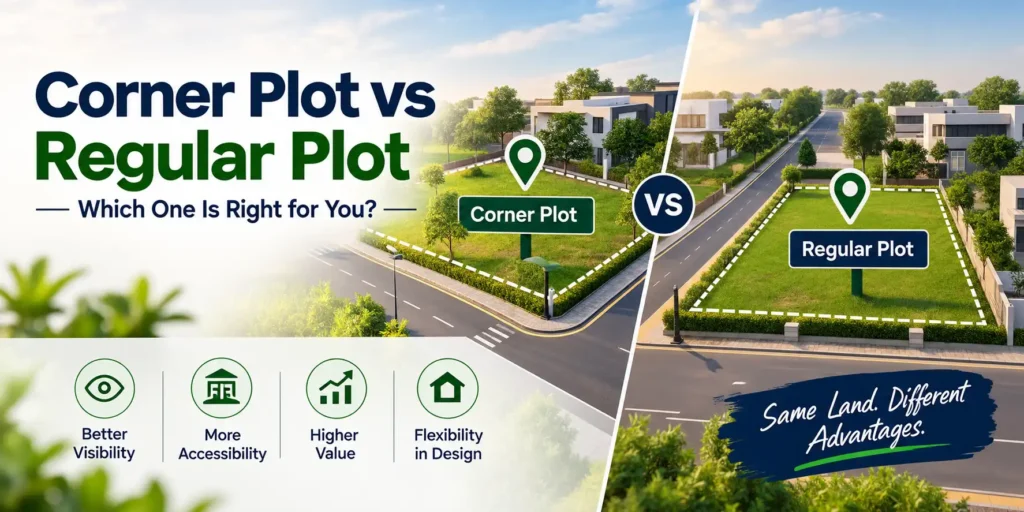
The decision about buying a plot is not dependent just on its price. This is because two plots with similar layouts can be priced differently, as the living experiences they offer may differ considerably. This is especially true when it comes to the corner plot vs regular plot debate.
If you are planning to buy a plot and are torn between the two, this plot-buying guide will help you understand what each option offers and how to match your choice to your budget and long-term goals.
What Is a Corner Plot?
A corner plot is situated at the intersection of two or more roads within a residential layout or township. As it is at a junction, it usually provides access to roads on two sides rather than one. Such plot placement offers ventilation, design flexibility, and accessibility, leading to higher prices. As these plots are viewed to be more open, they can be considered more prominent within a layout.
What Is a Regular Plot?
A regular plot is bordered by other plots and has a single side facing the street. It is a common type of plot in a residential layout. This type of plot offers a more contained and private living space. It is a default choice for most buyers as it offers a combination of affordability and straightforward ownership experience.
Why Are Corner Plots More Expensive?
A corner plot can command a premium between 10% and 30% over regular plots in the same layout. It can be costly owing to these factors:
- More accessibility and visibility: As they offer road frontage on two sides, corner plots can be accessed with ease and are more visible, which is why they can be valuable for anyone considering future commercial use.
- Greater size and usable space: Corner plots are usually larger or irregularly shaped, and they offer less room for additional parking, landscaping, or future extensions.
- Dual access: As there is access to two road-facing sides, both vehicle movement and layout planning can become simplified.
- Scarcity: Each residential layout will only have a few corner plots, and the limited supply along with steady demand can lead to a price rise.
- Stronger resale appeal: As buyers may be willing to buy these plots at higher prices, their resale value over time may also be higher.
The higher cost of corner plots is therefore due to their genuine structural advantages over regular plots.
What Are the Advantages of Buying a Corner Plot?
Listed below are some benefits of corner plot:
- Better ventilation and natural light
As two open sides are available, homes built on corner plots usually have better airflow and daylight. This is not just a factor that drives comfort; it can also minimise the dependence on artificial lighting and cooling.
- Greater design flexibility
Architects may have more space to work with when it comes to a corner plot. They can create multiple entrances, larger balconies, separate parking access, and wider windows. This becomes a realistic option when two sides face the street.
- Higher property value
Usually priced and valued higher than regular plots in the same residential layout, they can be a suitable pick if long-term capital growth is the primary goal.
- Extra parking and accessibility
The road frontage usually helps attain more space for parking, which can be an advantage in an urban layout where each square foot counts.
- Potential for commercial use
Due to their visibility, corner plots can be suitable for small commercial establishments. For buyers with flexibility as a priority, this type of plot can widen future options.
What Are the Drawbacks of Corner Plots?
- Higher purchase cost
Although the premium makes corner plots attractive, it can also make them less accessible for those with limited budgets.
- More traffic and noise
Being placed at a junction translates to a higher amount of dust, more vehicle movement, and noise. These may be understandable disadvantages for those who prefer a quiet setting.
- Reduced privacy
Corner plots can be more visible to passers-by. This may lead to homeowners investing in higher boundary walls or extra landscaping just for the restoration of a comfortable level of privacy.
- Higher maintenance costs
An open boundary and street-facing walls can lead to higher upkeep and can lead to more spending on lighting and security.
How Do Corner and Regular Plots Compare in Resale Value and Appreciation?
Corner plots are structurally distinct, and their benefits are typically attached to this uniqueness. These plots can attract many buyers, and across markets they command a resale premium of 10% to 20% over standard, single-frontage plots. For buyers with a primary goal of long-term capital growth, these plots can be suitable.
However, the broader property appreciation picture depends on certain basic factors such as the plot’s proximity to transport corridors, zoning status of the surrounding area, and the width of the approach road. If a corner plot is located in a stagnant location, a well-located regular plot may easily outperform it.
It is therefore important to understand that though the resale value of a corner plot in a given layout can be higher, location and infrastructure decide its value.
Which Plot Should You Choose Based on Your Budget and Goals?
There is usually no universally better option, as the choice between the two is dependent upon your personal goals.
Choose a corner plot if you want:
- Better ventilation and natural light
- Greater architectural flexibility
- Stronger long-term resale potential
- Extra parking space
- The option of future commercial use
Choose a regular plot if you want:
- A lower purchase price
- Greater day-to-day privacy
- A quieter, more settled residential environment
- Lower ongoing maintenance costs
Conclusion
If you are wondering is a corner plot worth buying, the answer may depend upon how much you value visibility and flexibility. If you are focused on corner plot investment benefits, the premium can be worth paying. If you want to prioritise affordability, a regular plot may be practically sensible. Whichever type of plot you lean towards, you must weigh the decision against the location’s growth and infrastructure trajectory. A thoughtful choice on both fronts will serve you far better than focusing on plot type alone.
FAQs About Corner and Regular Plots
1. Are corner plots better for investment?
Corner plots often make strong investment choices owing to their visibility, flexibility, and typically higher resale demand. However, whether they are better for investment ultimately depends on if their location is promising.
2. Do corner plots have higher resale value?
Generally, yes. Corner plots tend to attract a resale premium of around 10% to 20% over comparable regular plots, largely due to their superior ventilation, design flexibility, and visibility.
3. Which plot type is better for building a house?
Corner plots offer more design freedom, multiple entrances, larger windows, and flexible layouts. While more restrictive in design, one of the regular plot advantages is a more private and contained setting that many families prefer for everyday living.
4. Do corner plots appreciate faster?
Not necessarily. While corner plots carry a structural premium, the pace of appreciation is driven more by broader factors like new infrastructure, transport connectivity, and zoning changes than by plot type alone.
5. What factors affect plot value?
Plot value is shaped by a mix of factors: location and connectivity, the width of the approach road, zoning classification, nearby infrastructure projects, the socio-economic profile of the surrounding area, and, for corner plots specifically, added road frontage and ventilation.