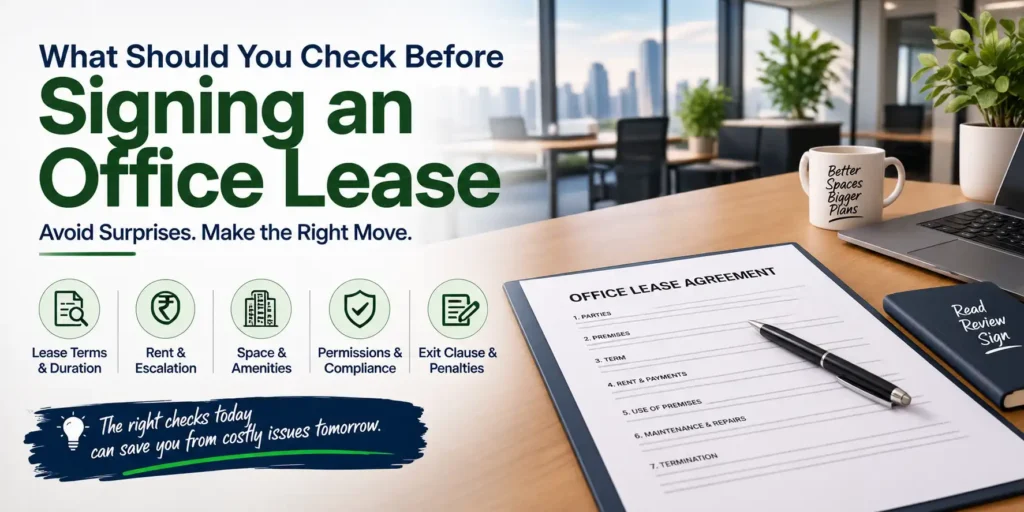
Carefully reviewing and signing an office lease agreement can make the leasing process less stressful. Once you sign the document, your room for negotiation shrinks. This is why having an accurate office lease checklist is important before making a commitment.
Whether you are renting your first workplace or relocating, this guide helps you understand what to check before you rent an office space.
Why Is It Important to Review an Office Lease Carefully?
A lease that has been carefully reviewed can protect the business’ future, as it can enable you to identify terms that may be problematic in the future. A commercial lease can have complex jargon and may therefore be hard to decipher. This is why it must be read through, and legal input must be sought.
A complete review can include going through the rent structure, repair duties, lease length, permitted use and hidden costs. This helps understand the agreement fully before the lease is signed. After it is signed, changing unfavourable terms may be difficult.
What Details Should Be Included in an Office Lease Agreement?
Apart from the specific clauses that will be covered in upcoming sections, every lease agreement should clearly set out these structural essentials:
- The parties involved: Understanding who is the landlord and confirming that the signatory is actually authorised.
- Lease tenure: Verifying the dates of the lease starting and ending and checking if there is any ambiguity about the same.
- Renewal conditions: Checking if you have the option to renew the lease, and what the terms for it are.
- Notice period: Looking at how much notice either party must give, and how it must be delivered.
- Property description: Checking the precise description of the premises, including area and permitted use.
Getting these administrative basics right sets the foundation; the clauses below build on it.
How Does the Lock-In Period Affect Tenants?
A lock-in period is a fixed stretch of the lease during which neither party can terminate the agreement. In India, this period can run from three to five years, depending on the available space and the lease terms. It is worth distinguishing this from the lease term itself. The lease term is the total duration of the lease, while the lock-in is the non-cancellable window within it. For the landlord, this period guarantees income stability, whereas for tenants, it assures that the space remains available.
Before signing, you must check if the lock-in is mutual, what the early exit penalties are and if they apply to force majeure. A well-drafted clause can offer protection to both sides.
What Hidden Costs Should Businesses Look For?
The quoted rent usually does not offer the entire picture. Separate charges may be applicable for electricity, parking, and maintenance, and they can quickly add up. Most businesses do not ask for these until the arrival of the first invoice.
Common extra charges to budget for include:
- Security deposit: This is the first major payment, and it is due before possession. Ask if it is refundable, what conditions trigger deductions, and when it’s returned.
- Common Area Maintenance (CAM): It covers shared spaces like lobbies, lifts, and security. Check if it has been included in the rent or will be billed separately.
- Fit-out costs: If the space is bare when handed over, the costs of workstations, cabling, and lighting may be added on.
- Parking and add-on charges: The charges for visitor parking and access cards can become separate fees.
The comparison of the office solely based on rent is therefore not the best route. Even if the rent is higher, if fewer add-ons are needed, overall costs may be low.
How to Evaluate Rent Escalation Clauses?
Rent escalation is the pre-agreed rent increase at the set intervals. Standard commercial structures in India run three to nine years, and escalation is triggered every twelve months at around 5%, or more commonly every three years, at up to 15%.
When checking the escalation clause, check exactly what the increase applies to. Some landlords may apply it to the gross rent, which includes maintenance charges, rather than the base rent. This can inflate costs unfairly. It is also important to confirm the trigger date, as the rent commencement date versus the handover date can shift when a hike applies.
What Legal Documents Should Landlords Provide
Before you sign, you must check if the landlord can provide clear documentation and prove their right to lease the property:
- Title deeds verified through the chain of ownership at the local Sub-Registrar’s office.
- Occupancy and Completion Certificates from municipal authorities, as their absence can lead to serious issues such as demolition orders.
- An Encumbrance Certificate (EC) that covers the last 15–30 years, displaying any existing mortgages, liens, or legal disputes on the property.
- Confirmation that local zoning permits business activity at that location, as a discrepancy can lead to a forced shutdown.
- The registered lease agreement itself, as an unregistered or under-stamped lease is inadmissible in court.
Such due diligence and consultation with a property lawyer for long-term or high-value leases can minimise the risk of disputes as time passes.
How Can Businesses Negotiate Better Lease Terms?
Leases can be negotiated to some extent. It is not necessary for a tenant to sign a lease they are provided. Here are a few practical steps that can help shift the terms in your favour:
- Understand your costs and lease type: Understanding upfront costs is important, as gross, net, and percentage-rent structures shift different expenses onto the tenant.
- Check market rents: An evaluation of the rent in the area can help assess if the asking price is reasonable.
- Ask for tenant inducements: Check the rent-free period or a renovation contribution, especially if the space has been vacant for a while.
- Review termination and renewal conditions: Check such terms and verify if subleasing is permitted if your needs change.
- Involve a commercial lawyer: This is an important step before signing, as a professional can identify errors that a general read-through may miss.
Landlords generally expect some negotiation, so raising these points is standard practice.
Conclusion
Checking an office lease thoroughly is important, right from the lock-in period and rent escalation to hidden costs and legal documentation. Thorough verification separates a smooth tenancy from a costly one. This office lease agreement checklist can be a good starting point. You must ensure that you ask questions whenever something is unclear and seek professional advice where the stakes are high.
FAQs About Office Lease Agreements
1. What is a lock-in period in an office lease?
This is a fixed period during which neither party can terminate the lease. In India, this commonly ranges from three to five years, within the broader lease term.
2. How much security deposit is typically required?
This varies by property and market, so it’s best confirmed directly with the landlord. What matters more is clarity: ask when it’s refundable, what could lead to deductions, and how quickly it’s returned once the lease ends.
3. Who pays maintenance charges?
Who pays maintenance costs depends on how the lease is structured. In some agreements, it is tied to the rent; in others, it’s billed separately. Understand the lease structure before signing.
4. Can lease terms be negotiated?
Yes. Rent, lock-in duration, escalation rates, and fit-out contributions are all commonly negotiated, especially on longer or larger leases.
5. What happens if a lease is terminated early?
This depends on how the termination and lock-in clauses are drafted. Typically, the tenant pays the remaining rent for the lock-in period, or a pre-agreed penalty, though exceptions like mutual agreement or force majeure are sometimes built in.